
AI Photo Booth vs. Traditional Photo Booth: Which Fits Your Event?
A photo booth can be one of the simplest ways to bring people together at an event. Guests step in, take a photo, and leave with something that reminds them of the experience. But as photo booth technology has evolved, the possibilities have expanded well beyond traditional photography.
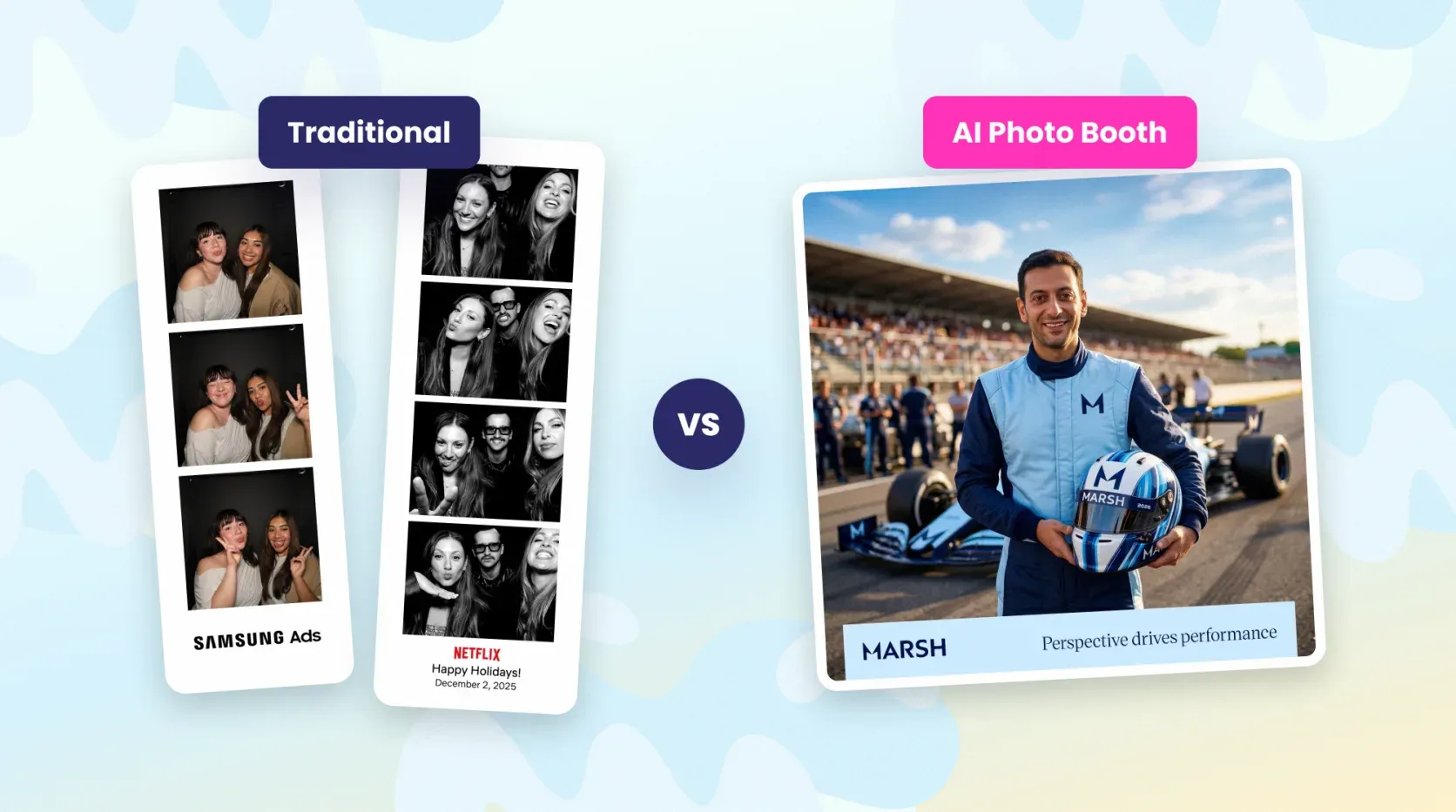
Today, event planners can choose between classic enclosed photo booths, open-air digital experiences, and AI-powered activations that transform guests into characters, athletes, or entirely new versions of themselves.
That creates an interesting question for brands and event organizers: Is an AI photo booth actually better than a traditional photo booth, or does the right choice depend on what you're trying to achieve?
OutSnapped has helped brands create memorable experiences in very different ways, from UNIQLO’s traditional photo booth at MoMA and Marine Layer’s retail activation to AI-powered experiences for SoFi, Mount Sinai at the US Open, Freshworks, and Marsh. Each activation served a different purpose, whether encouraging customer engagement, creating personalized branded content, or bringing a campaign to life. These real-world examples show why choosing between a traditional and an AI photo booth isn't simply about technology. It's about finding the right experience for your audience and event goals.
Published on
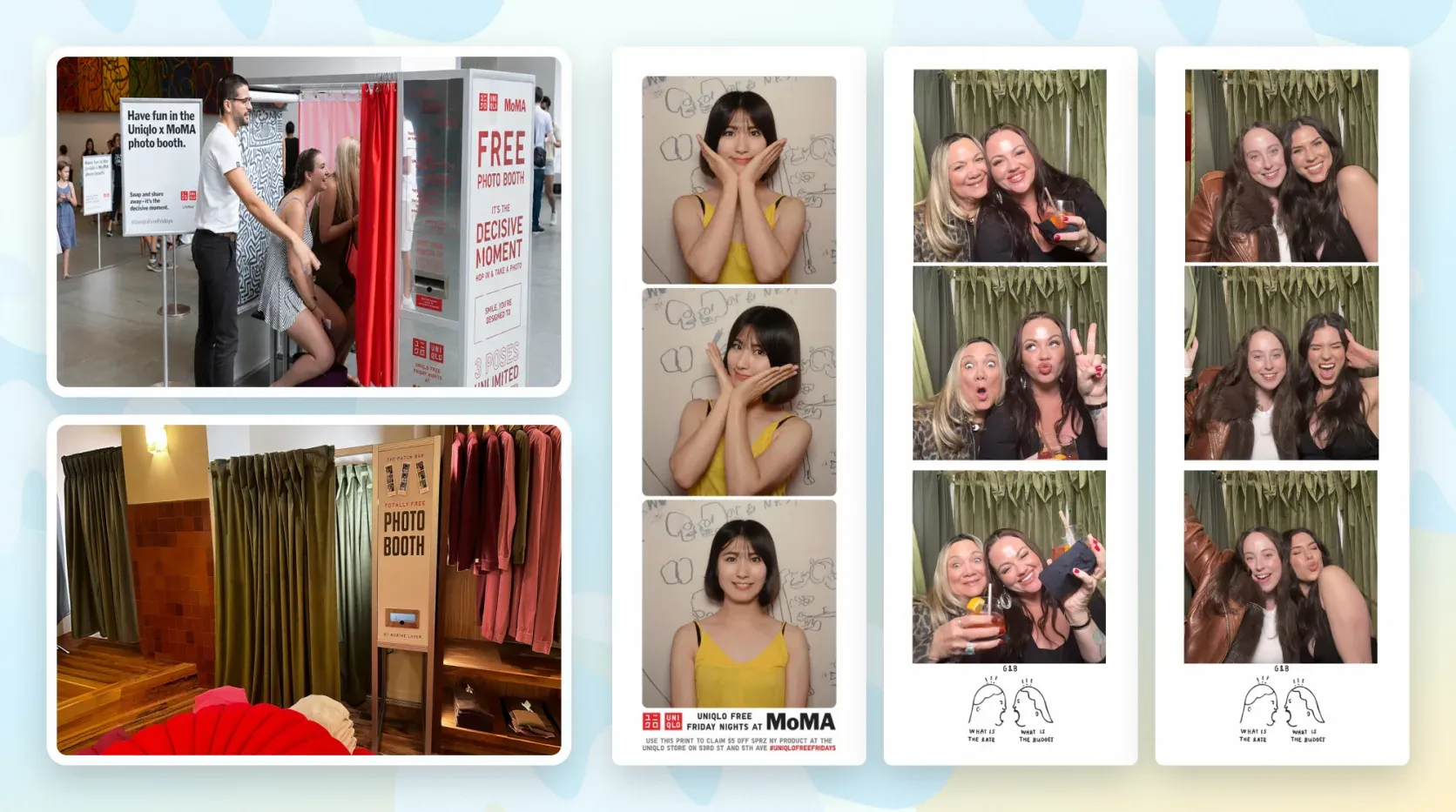
Traditional photo booths capture real moments and create branded keepsakes for corporate events, retail activations, and celebrations.
Traditional Photo Booths Still Have a Place in Modern Brand Activations
There's a reason traditional photo booths remain popular. They're familiar, easy to use, and give people an opportunity to capture a real moment with the people around them.
A traditional photo booth doesn't have to be a generic box in the corner of a room. Modern enclosed booths can feature custom branding, themed interiors, printed photo strips, digital sharing, and promotional messages that connect the experience to a larger campaign.
For brands, that familiarity can be an advantage. Guests don't need to understand a new technology or choose between complicated creative options. They know what to do, and the resulting photograph feels personal because it captures a moment that actually happened.
UNIQLO × MoMA: A Familiar Experience in an Iconic Setting
When UNIQLO sponsored Free Friday Nights at The Museum of Modern Art, the experience needed to complement the museum visit rather than compete with it.
OutSnapped provided a traditional enclosed MagBooth with UNIQLO-red curtains, branded details, and printed photo strips. Visitors could step inside, pose with friends or family, and leave with a physical keepsake from their evening.
The photo strips also incorporated a retail offer, connecting the museum experience to a potential future interaction with the sponsor.
Across six Fridays, the activation recorded 1,199 photo sessions, averaging approximately 200 per evening.
The appeal wasn't a technological transformation. It was the opportunity to capture a shared memory in a familiar format, with branding that felt appropriate to the environment.
Read the UNIQLO × MoMA case study.
Marine Layer: Connecting Retail Engagement With Customer Data
For retail brands, a photo booth can do more than create a keepsake. It can provide an interactive reason for customers to engage with the brand while supporting broader marketing objectives.
OutSnapped's Marine Layer retail activation recorded 959 sessions and 271 email captures.
Those numbers illustrate two different kinds of value. The sessions demonstrate participation, while the email captures show how an in-person photo experience can also support contact collection.
A traditional photo experience can be especially effective in a retail environment because it doesn't require shoppers to learn a new interaction. The activity feels approachable, while the branded output gives them something to remember the store experience by.
Of course, collecting an email address isn't the same as generating a sale. The value depends on how the brand follows up and whether participants have consented to further communication. But the activation shows how a familiar photo experience can support both engagement and a measurable marketing action.
Analog Events: Why Classic Photo Booths Work for Corporate Celebrations
Corporate celebrations have different priorities from retail campaigns. At a holiday party or company social, the goal is often to help people relax, connect, and leave with a shared memory.
OutSnapped delivered an enclosed MagBooth for an Analog Events holiday celebration in December 2025. The experience included custom-branded photo strips, unlimited printing, a digital gallery, and a choice between black-and-white and color photographs.
The following year, Analog Events returned for another corporate social event, this time with a branded MagBooth experience that included printing and a requested vinyl wrap.
These two events demonstrate why traditional photo booths continue to work well for corporate gatherings. Guests can participate together, the photographs preserve real interactions, and physical prints become personal souvenirs.
For an event where the people in the room are the main attraction, that may be exactly what the experience needs to accomplish.
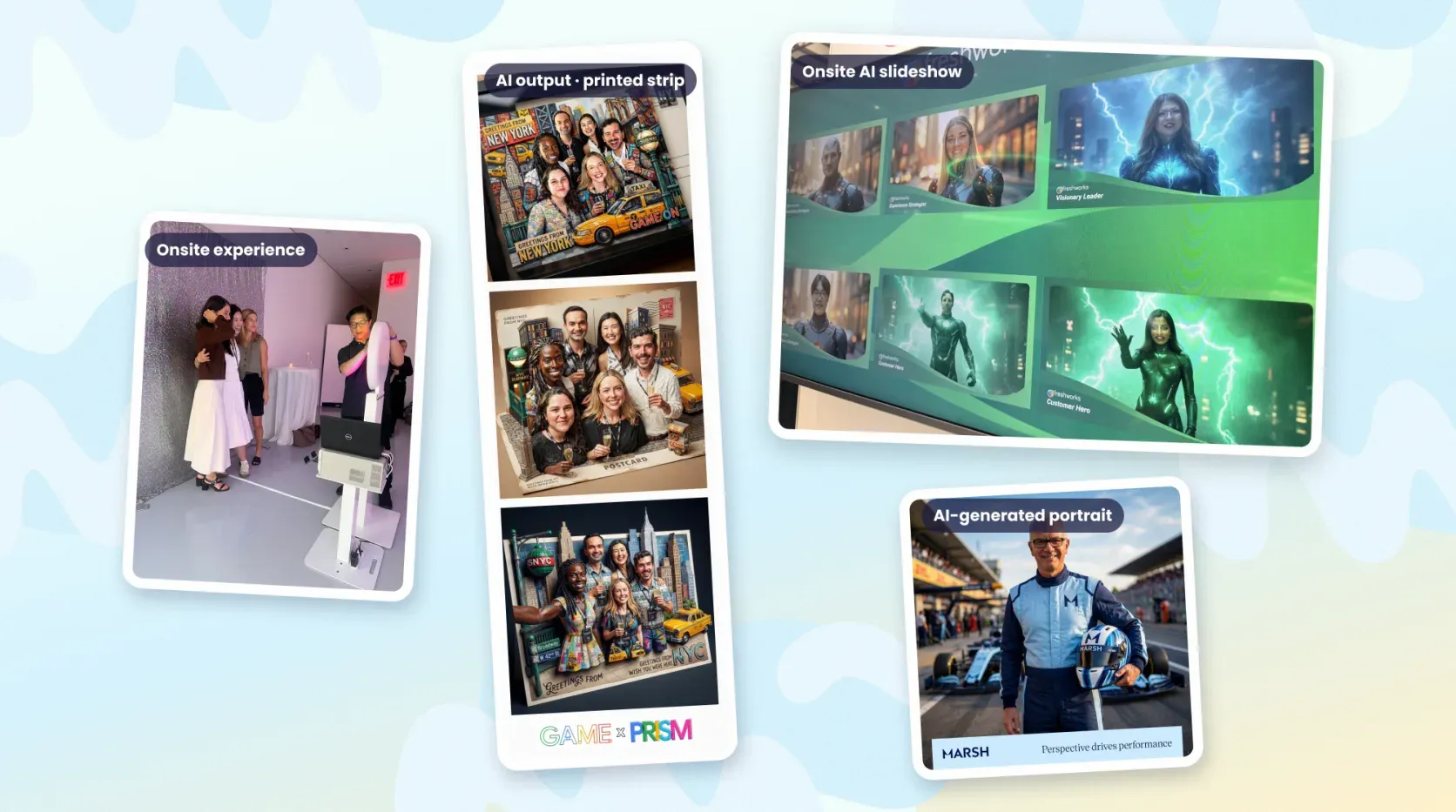
AI photo booths transform guest portraits into personalized branded images, with options for digital sharing and printed photo strips.
What Makes an AI Photo Booth Different?
An AI photo booth also starts with a photograph, but what happens afterward changes the experience.
Instead of simply preserving the original image, AI technology can transform a guest's appearance, clothing, background, or surrounding environment. Depending on the creative concept, participants might become superheroes, championship athletes, futuristic characters, or the faces of a brand campaign.
That opens up opportunities that traditional photography cannot easily reproduce. Brands can create imaginative scenes without building physical sets for every possible outcome, and guests can receive content designed around a particular campaign message.
The difference is especially meaningful when the transformation is connected to the reason the event exists.
SoFi: Making the Face of Finance Personal
SoFi's Face of Finance campaign challenged conventional perceptions of who represents the financial industry, particularly the visibility of women in finance.
Rather than asking guests to pose in front of a standard branded backdrop, the AI-powered experience invited them to become part of the campaign's visual story.
The activation generated 446 shareable videos, 537 social shares, an estimated reach of 48,508, and 154,825 total impressions.
Those figures show how a personalized experience can extend beyond the original interaction. Guests didn't just receive a photograph of themselves attending an event. They received campaign-related content they could share with their own networks.
The technology mattered because it supported the message. AI gave participants a way to see themselves represented within the creative concept.
Mount Sinai: Turning US Open Fans Into Champions
At the US Open, Mount Sinai used a custom AI experience to connect with tennis fans through personalized content.
The 2026 activation featured champion and player personas, allowing participants to see themselves transformed into tennis-inspired characters. The experience also included AI animation and a QR-based participation option.
This is a different kind of brand interaction from a traditional photo booth. Fans aren't simply documenting that they attended the tournament. They're becoming part of an imagined tennis moment.
For sports sponsorships, that creative transformation can connect the brand to the excitement of the event while giving guests a personalized takeaway.
Freshworks: Using AI to Stand Out at a Trade Show
At the 2026 Customer Contact Week trade show in Las Vegas, Freshworks used an AI Lookbook experience to create superhero-themed portraits for attendees.
The activation included a branded kiosk, onsite support, and a real-time slideshow.
The superhero concept gave attendees a clear reason to participate, while the slideshow helped make the experience visible to people passing the booth.
This illustrates an important advantage of AI at trade shows: the output itself can become part of the attraction. When attendees can see the transformations being created, the experience has an opportunity to generate curiosity before someone even approaches the booth.
However, attracting a crowd and generating qualified leads are different outcomes. For exhibitors, the activation still needs to fit into a broader strategy for starting conversations and following up with potential customers.
Marsh: Bringing a Corporate Event Theme to Life
AI isn't limited to consumer campaigns or public-facing brand activations.
For Marsh's June 2026 leadership meeting, OutSnapped supported an F1-themed AI photo experience using both Lookbook and custom AI capabilities.
The activation was designed around the event environment, with booth placement coordinated near racing simulators and participation planned around breaks in the meeting schedule.
Here, AI supported a corporate event by making the theme more personal. Rather than taking a conventional event photograph, participants could receive a creative output connected to the racing concept.
The example also shows that successful AI activations require practical planning. Lighting, booth placement, guest flow, and testing all matter, particularly when the output depends on consistent photo capture.
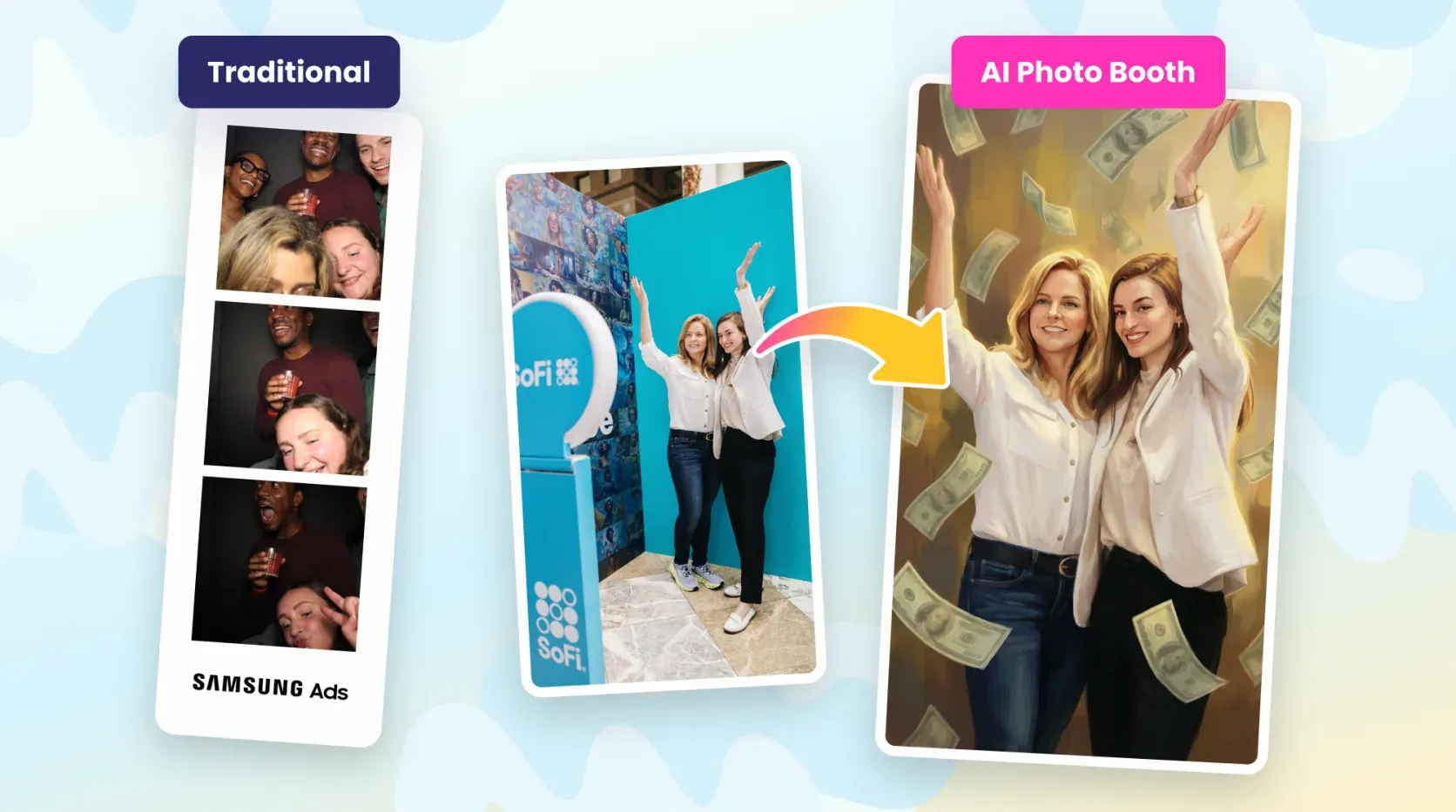
Traditional photo booths capture authentic moments, while AI photo booths create personalized transformations for branded event experiences.
AI Photo Booth vs. Traditional Photo Booth: Key Differences
Both formats can be branded, support digital sharing, and contribute to event marketing goals. The main distinction is the kind of experience guests have and the content they receive.
Feature | Traditional photo booth | AI photo booth |
|---|---|---|
Guest output | Real photographs, printed strips, digital images | AI-generated or transformed images and videos |
Guest experience | Familiar, social photography | Photography followed by a creative transformation |
Group participation | Especially well suited to friends and coworkers | Depends on the AI configuration |
Branding | Custom booths, curtains, backgrounds, overlays, prints | Custom visual worlds, characters, styles, and transformations |
Printing | Commonly offered | Available with compatible setups |
Digital sharing | Yes | Yes |
Lead capture | Can be integrated | Can be integrated |
Creative development | Primarily physical and graphic design | May require AI concept development, testing, and customization |
Best suited for | Shared memories, celebrations, retail keepsakes | Campaign storytelling, themed activations, personalized content |
The comparison isn't about which technology is more advanced. It's about which guest experience makes the most sense for the occasion.
Which Photo Booth Creates a Better Guest Experience?
The best event experiences are the ones people actually want to participate in.
Traditional photo booths have the advantage of familiarity. At a corporate celebration, coworkers can step into a booth together without needing instructions or explanations. The experience is social from the beginning, and the final photograph captures the interaction itself.
AI photo booths create anticipation in a different way. Guests know what they look like when the photograph is taken, but they may not know exactly how the transformation will turn out. The reveal becomes part of the entertainment.
That element of surprise can be particularly effective at themed events and brand activations. A superhero transformation at a trade show or a tennis champion portrait at a sporting event gives participants something they couldn't easily create with an ordinary camera.
But more technology can also introduce more complexity. AI experiences may involve additional processing time, creative selections, or technical requirements. At a high-volume event, those considerations need to be balanced against expected attendance and the amount of time guests have available.
A well-designed traditional booth may deliver a smoother experience than an unnecessarily complicated AI concept. Equally, a carefully planned AI activation can make a campaign feel more distinctive than a standard photograph.
How Much Does Branding Matter?
Both formats offer substantial opportunities for customization, but they approach branding differently.
With traditional photo booths, the brand often becomes part of the physical environment and final photograph. A custom enclosure, branded photo strip, or themed backdrop can make the experience feel connected to the event.
UNIQLO's MoMA activation is a good example. The booth complemented the museum setting while incorporating recognizable sponsor branding and a retail offer into the printed takeaway.
Analog Events used traditional booth customization for a different purpose: creating a polished experience appropriate for corporate celebrations.
AI can take branding further by incorporating the campaign concept directly into the content. SoFi used personalized visuals to reinforce its Face of Finance message. Mount Sinai used tennis-themed transformations to connect participation with the US Open. Freshworks used superhero imagery to create an engaging trade show experience.
In each case, the brand experience was more than a logo on an image.
Still, a customized AI portrait isn't automatically more effective than a traditional photograph. The creative concept needs to make sense for the audience and the campaign. If the transformation feels disconnected from the brand, it may generate curiosity without creating meaningful brand recognition.
Which Photo Booth Is Better for Lead Generation and Social Sharing?
Traditional and AI photo booths can both support measurable marketing outcomes, but those outcomes should be defined before selecting the technology.
For lead generation, either format can include digital delivery, consent-based email collection, and relevant qualification questions. Marine Layer's 271 email captures demonstrate how a traditional retail photo experience can support contact collection alongside participation.
For social sharing, AI experiences may offer more opportunities for unusual or highly personalized content. SoFi's campaign demonstrates how transformed content can be distributed beyond the event through participant sharing.
But neither format guarantees leads or social reach.
A trade show attendee who takes an AI portrait isn't automatically a qualified prospect. Similarly, someone who shares a traditional photo strip may have enjoyed the experience without developing an interest in the sponsoring brand.
The important question is what the activation is designed to achieve after participation.
If the goal is lead generation, consider how contacts will be collected, qualified, and followed up with. If the goal is brand awareness, evaluate the content people receive and whether it encourages sharing. If the goal is employee engagement, participation and the quality of the shared experience may matter more than public social metrics.
For exhibitors, explore how trade show photo booth experiences can connect guest engagement with broader event marketing goals.
How Do AI and Traditional Photo Booth Rental Costs Compare?
Cost is another important consideration, although comparing the two formats isn't always straightforward.
Traditional photo booth pricing depends on the booth type, rental duration, staffing, location, printing, and level of customization. A standard enclosed booth for a company celebration may have different production requirements from a fully branded installation at a national event.
AI photo booth pricing can also vary significantly. An experience using an existing AI Lookbook style generally requires a different level of creative development from a fully custom transformation built for a specific campaign.
The scope matters as much as the technology. A single-day corporate activation, a multi-day trade show, and a major sports sponsorship can have very different staffing, hardware, content, and operational requirements.
Before comparing quotes, ask what is included in the proposed experience. Consider the number of stations, expected participation volume, available outputs, printing, creative development, digital delivery, and onsite support.
The goal isn't necessarily to select the least expensive format. It's to choose the experience that can deliver the outcomes your event needs without paying for complexity that doesn't contribute to those objectives.
Choosing the Right Photo Booth for Your Event
Looking across these OutSnapped activations, a few patterns emerge.
For corporate parties and employee celebrations, traditional photo booths are often a natural fit because they encourage group participation and create tangible memories. Analog Events demonstrates how a familiar format can be customized for a polished corporate setting. AI becomes more relevant when the event has a strong creative theme, as Marsh's F1-inspired experience illustrates.
For retail experiences, traditional photo booths can connect in-person engagement with branded keepsakes and customer data. Marine Layer shows how participation and email collection can work together, while UNIQLO demonstrates how a physical photo strip can carry sponsor messaging beyond the original experience.
For trade shows, AI can be particularly useful when exhibitors need a distinctive visual concept that attracts attention. Freshworks' superhero portraits illustrate how the transformation itself can become part of the booth's appeal. Traditional photography remains a viable option when the experience offers useful or desirable content for attendees.
For brand activations and sports sponsorships, AI can help guests become part of a campaign's story. SoFi's Face of Finance and Mount Sinai's US Open experiences show how personalized content can connect participation to a larger creative message.
These aren't strict rules. A traditional photo booth can be a strong brand activation, and AI can be entertaining at a corporate party. The format should follow the audience, environment, and purpose of the event.
Measuring Success Beyond the Number of Photos Taken
One of the biggest mistakes in experiential marketing is assuming that participation alone proves an activation was successful.
Sessions tell you how many interactions occurred. Outputs show how much content was created. Shares and views can indicate how far that content traveled. Email captures can support lead generation, but they don't automatically represent qualified leads or sales.
Different campaigns should therefore be evaluated against different goals.
UNIQLO's 1,199 sessions demonstrate participation across recurring museum events. Marine Layer's 959 sessions and 271 email captures show both engagement and contact collection. SoFi's 537 social shares and 154,825 impressions demonstrate another kind of outcome: campaign content reaching audiences beyond the activation.
These numbers shouldn't be treated as a competition between traditional and AI photo booths. The events had different audiences, durations, and objectives.
What they show is that the right reporting starts with a clear understanding of what the experience is supposed to accomplish.
So, Is an AI Photo Booth or a Traditional Photo Booth Better?
If your event is centered on people spending time together, capturing authentic memories, and leaving with physical keepsakes, a traditional photo booth may be the stronger choice.
If your campaign depends on imaginative storytelling, personalized transformations, or placing participants inside a branded visual world, an AI photo booth may offer more creative possibilities.
Neither option guarantees better engagement, more leads, or greater social reach. Those results depend on the audience, creative concept, execution, and follow-up strategy.
OutSnapped creates both traditional and AI-powered photo experiences for corporate events, trade shows, brand activations, retail environments, and long-term installations.
Whether you're looking for classic printed photo strips or a fully customized AI transformation, the right starting point is understanding what you want guests to experience and what you want the activation to achieve.
Frequently Asked Questions About AI and Traditional Photo Booths
A traditional photo booth captures guests as they appear, typically delivering printed or digital photographs. An AI photo booth transforms captured images into new creative outputs, such as personalized portraits, characters, or themed environments. The main distinction is whether the experience preserves a real moment or creates an imagined one.
AI photo booths can involve additional creative development and technical requirements, particularly for custom brand activations. However, pricing for both formats depends on event duration, staffing, location, branding, printing, and production scope. A customized traditional installation can cost more than a simpler AI experience, so comparing equivalent proposals is important.
Yes. Traditional photo booths can support consent-based email collection, digital delivery, surveys, and other marketing integrations. OutSnapped's Marine Layer activation, for example, recorded 959 sessions and 271 email captures. The quality of those contacts and their eventual conversion depend on the broader marketing strategy.
Both can work well. AI photo booths are useful when a creative transformation supports the exhibitor's message and attracts attendee interest. Traditional photo booths can be effective when they offer a familiar, desirable takeaway. The right choice depends on the audience, available space, guest flow, and whether the priority is awareness, lead generation, or engagement.
Yes. Certain AI photo booth configurations support printed outputs alongside digital delivery. Printing availability depends on the setup, image format, and production requirements.
Yes. Traditional photo booths can feature branded enclosures, curtains, backdrops, printed layouts, photo strips, digital overlays, and promotional messaging. Customization can make a classic photo experience feel closely connected to a brand without changing the familiar guest interaction.