When the team behind The Startup Musical, a musical exploring tech culture, data ethics, and the human cost of Silicon Valley ambition, wanted to blur the line between story and audience, they turned to Outsnapped. Together, they created a live photo experience that placed real audience members inside the world of Kazoo, the fictional app at the heart of the show. The result was more than a gimmick. It was a piece of storytelling. And it turned out to be an early example of something much bigger: a fundamental shift in how live events use AI photo experiences to make audiences feel like part of the story.
The Startup Musical is built around ideas that can feel abstract: data privacy, algorithmic manipulation, influencer culture, ethical leadership in tech. The risk with any show like this is that the audience watches from the outside, intellectually engaged, but never emotionally invested.
Co-creator and Lead Producer Patrick Storck wanted something different. He wanted audiences to feel what it means to hand over your image, your likeness, your data, before the show even started.
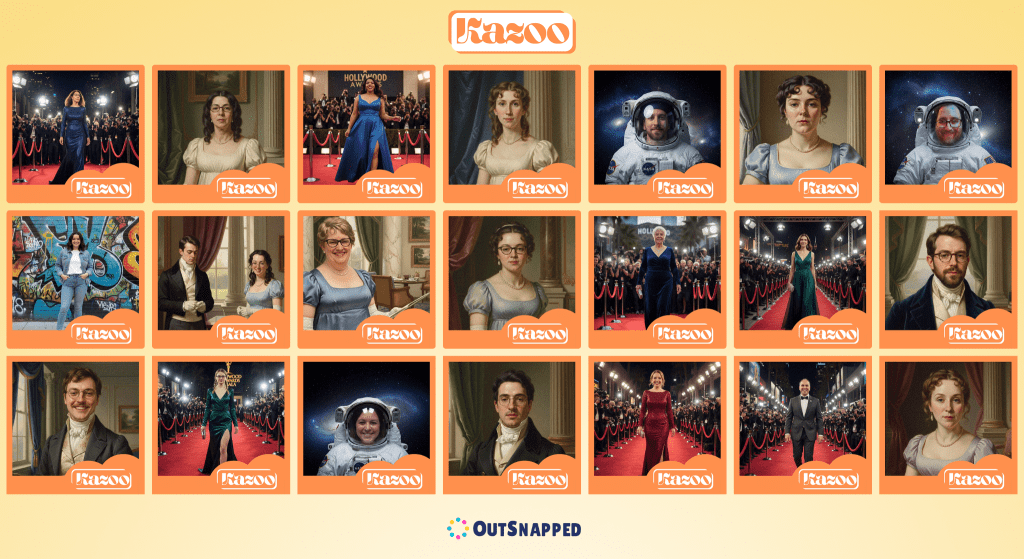
Outsnapped built and deployed an interactive photo experience modeled on Kazoo, the in-world app from The Startup Musical.
The flow was simple and intentional: guests arrived at the venue, took a photo of themselves through the Kazoo app experience, and then — as they made their way to their seats — saw their own faces appear onstage and throughout the space around them.
The experience was seamless, intuitive, and, crucially, fun. By the time the lights went down, the audience wasn't just watching a show about an app. They had already used one.
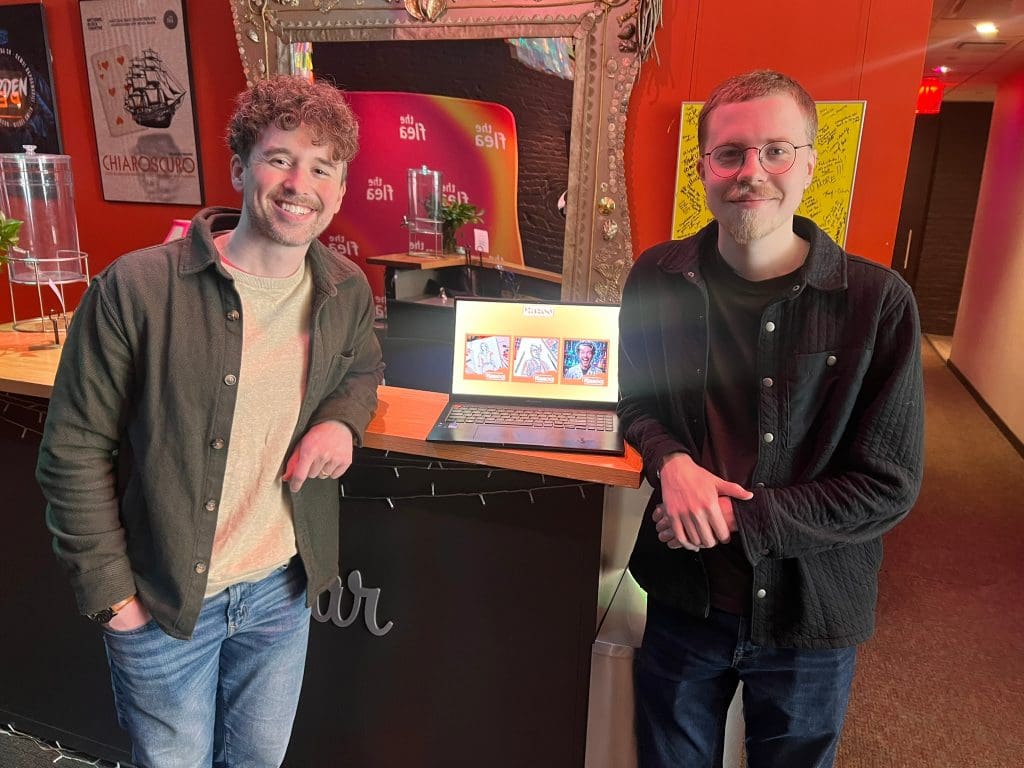
The energy shift was immediate. As Patrick described it:
"Audience members got really excited when their photos appeared onstage before the show began. Especially when they would see a friend or family member they were seeing the show with. I think we all get a little giddy when we see parts of ourselves onstage."
The pre-show became its own moment, guests pointing at screens, laughing with strangers, already invested before a single line was delivered.
That investment paid off during the pitch meeting scene, where audience photos appeared in the exact visual styles the characters were discussing onstage. Abstract ideas about data, who owns it, who profits from it, what it looks like when it's used without your full understanding, suddenly had a face. The audience's own face. The show's argument became personal in a way no amount of dialogue alone could achieve.
What made this collaboration land went beyond novelty. Outsnapped came to it with a rare combination of creative and technical expertise, years spent at the intersection of photography, live events, and emerging technology, understanding both the artistic intent behind an experience and the engineering required to make it feel effortless.
As Nicholas put it during the post-show talkback:
"Even speaking with you two or three years ago, the idea of being able to do what we did together was something unique to my company, Outsnapped. And to see how much has changed in that time — wild."
But the real depth of the impact came from what the experience asked the audience to do before they even sat down. By interacting with Kazoo, handing over their image, seeing it displayed as content , they had already lived the show's central question. What do we give away when we engage with technology? What does it feel like to see yourself used?
By the time those questions were being explored onstage, the audience had already answered them. With their own faces.
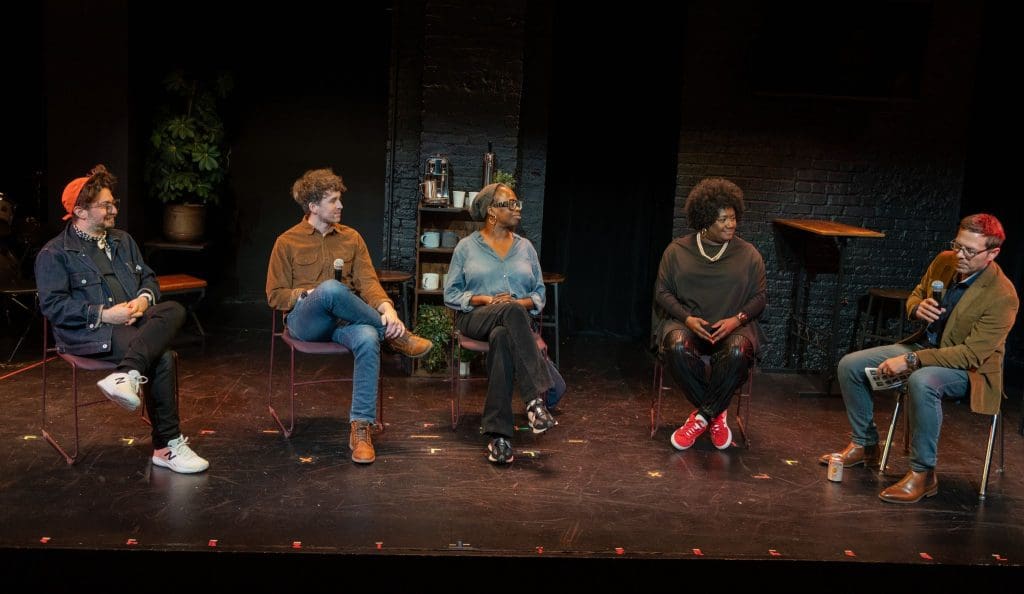
Dr. Renée Cummings, data scientist, criminologist, and professor at the University of Virginia's School of Data Science, captured it perfectly during the talkback: "I've never seen anyone sing about data. This was the ultimate data love story." The Outsnapped integration was a key part of making that emotional bridge possible.
To understand whether this approach is worth it for other shows, we asked Patrick, the Co-creator and Lead Producer of The Startup, if he would recommend integrating an interactive photo booth to deepen audience engagement. Here’s what he said:
"Absolutely yes. Any tool that we can utilize to bring audiences closer to the story, especially nowadays, is huge. We want our audiences to be engaged — and finding unique and innovative ways to do this helps bring in larger and curious audiences."
The Startup Musical is one production — but it's part of a much bigger wave of shows, brands, and festivals turning to AI photo experiences to create that same sense of personal stakes. For theatre, that means audiences who arrive curious and leave as advocates. For brands and live events, the opportunity is even broader.
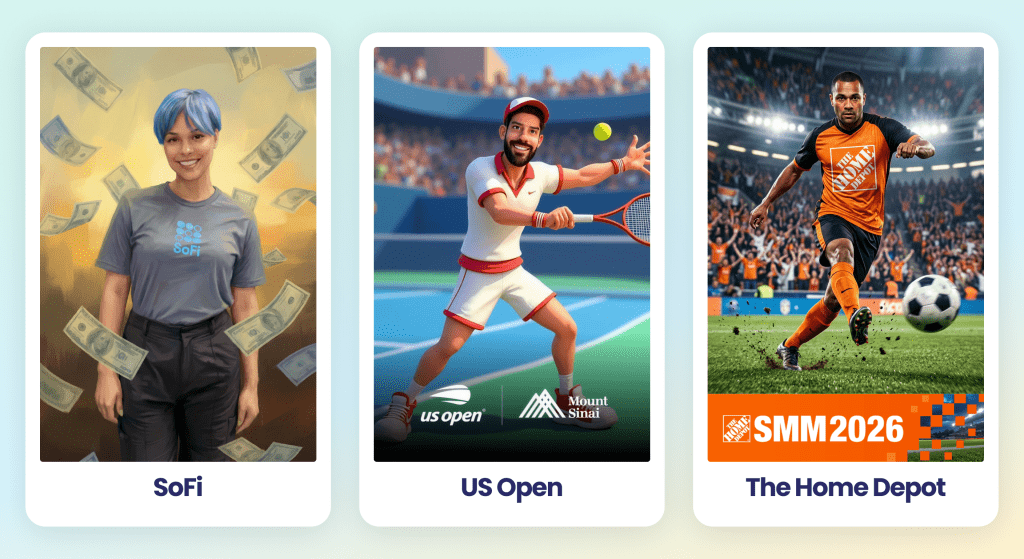
What Outsnapped brought to market years ago has now become one of the defining trends in experiential marketing. Global experiential marketing spend reached $128.35 billion in 2025, with budgets continuing to shift toward live, immersive activations that create genuine audience connection.
The case for AI photo experiences within that shift is straightforward: 83% of marketers say experiential activations drive more brand awareness than traditional digital ads, and AI photo booth activations consistently outperform other event touchpoints on brand recall and social sharing. On average, each interaction generates 3.2 social shares and between $2.50 and $5.00 in earned media value, meaning a single 500-person event can produce thousands of dollars in organic reach.
The biggest names in tech have arrived at the same conclusion. Google's Gemini API-powered photo activations use generative AI to analyze and reimagine guest portraits in real time, no static filters, but full image transformations delivered in seconds, with prints and shareable digital assets on the spot. At this year’s Coachella, AI-powered photo experiences have become part of the premium experiential footprint, giving attendees something genuinely personal to take home and post.
The signal is clear: personalized AI image experiences are no longer a novelty. They are becoming the expected standard.
That is exactly what Outsnapped has been building toward, not AI for the sake of it, but AI in service of a story, a brand, and a moment worth remembering.
The Outsnapped team was an early mover in this space, building bespoke AI photo and video experiences long before the market caught up. That head start matters in several important ways.
The technology is proven in live event conditions, under pressure, at scale, with real audiences who have zero patience for friction. The Startup collaboration is a direct example: a Broadway-adjacent production with a specific narrative need, delivered without a hitch.
The creative process is also different at Outsnapped. The starting point is always the story, the brand, the world, the feeling you want a guest to walk away with. The technology is in service of that. Not the other way around.
AI photo booths, when done right, are one of the smartest, most fun tools in the experiential marketer's toolkit, and they are only getting better. Outsnapped has been doing it right since before it was a trend.
AI photo and video experiences can be customised for almost any context, theatrical productions, brand activations, film premieres, corporate events, festivals, product launches, and beyond. The output format, visual style, brand integration, and delivery method are all configurable. What does not change is the core effect: guests feel like part of something, and they carry that feeling with them when they leave.
If you are a producer, a brand, or an event organiser thinking about what the version of this looks like for your project, that conversation starts with Outsnapped.
Outsnapped is an events-based company specializing in AI-powered photo and video experiences. The company has been at the forefront of immersive audience technology, from AI photo booths to interactive installations, helping productions, brands, and live events create moments that feel personal, surprising, and genuinely memorable.
"We invited audience members into the conversation, so that when they spoke about the app in the show, they knew what they were talking about. It allowed them to feel a part of the story." — Patrick, Co-creator and Lead Producer, The Startup